
Articles
Written by Kawin Jiaranaisakul

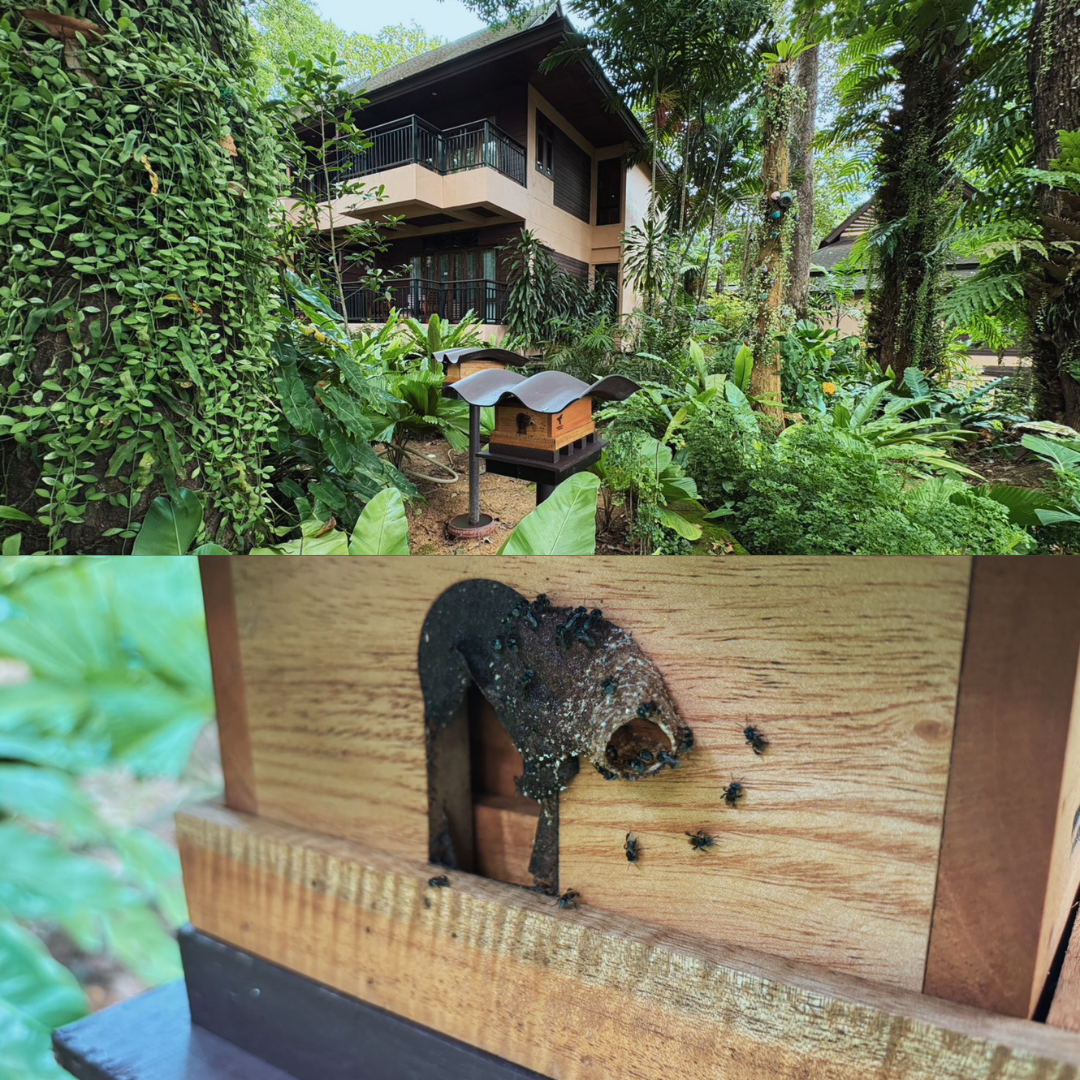
If you walk slowly past the flowering shrubs here in the morning, you might notice a small dark insect moving in and out of a narrow, waxy tube built into a gap in a wall or a hollow branch. It looks a bit like a fly at first glance. Look closer and you will see it is actually a bee, one of the smallest and gentlest bees you will ever meet. This is the silver haired stingless bee, known locally as chan-rong-khon-ngern, and its scientific name is Tetragonula pagdeni.
The name comes from the fine silvery hairs covering its small black body, which catch the light and give it a soft shimmer when it flies through a sunbeam. It is one of several stingless bee species found in Thailand, and one of the most commonly kept by local beekeepers because it produces good honey and handles heat well.
Unlike honeybees, stingless bees genuinely cannot sting you. Their stinger has been reduced through evolution to the point where it no longer works as a defense weapon. Instead, if a colony feels threatened, the workers will bite gently with their tiny jaws or simply crawl into your hair, which can be startling but is completely harmless. This makes them one of the easiest pollinators to observe up close, even for guests who are nervous around bees. Children especially enjoy watching them come and go from the nest entrance, which is often shaped like a short funnel or tube made from a dark, waxy material called cerumen.
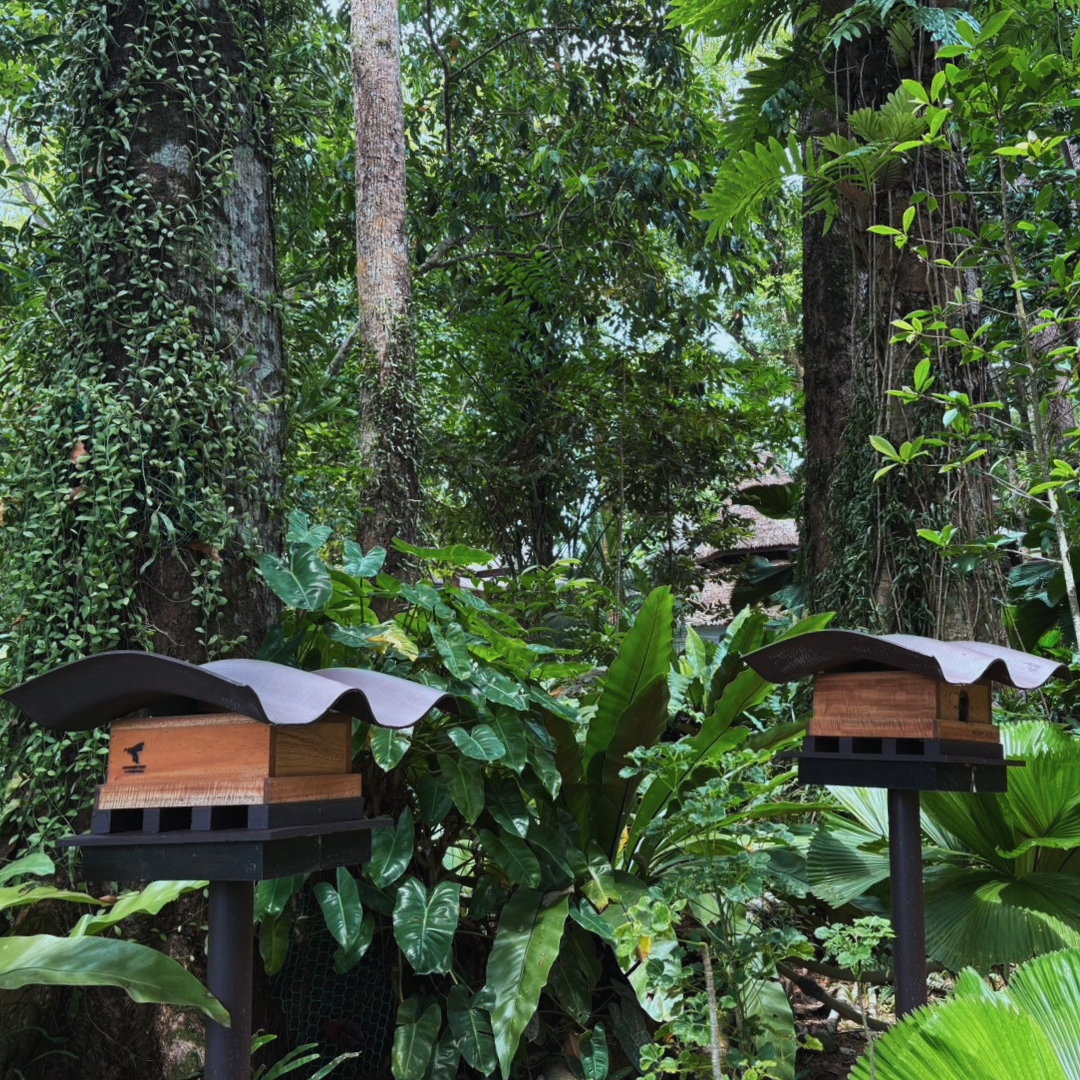
One thing that makes stingless bees different from honeybees is how far they travel to forage. While a honeybee might fly kilometers from its hive, a colony of Tetragonula pagdeni usually sticks to a much smaller area, often just a few hundred meters around the nest. This means the bees you see here are almost certainly feeding on flowers growing right around the resort grounds and the surrounding forest edge. In a way, a healthy population of these bees is a small sign that the plant life nearby is doing its job, offering enough nectar and pollen close to home to keep a colony fed year round.
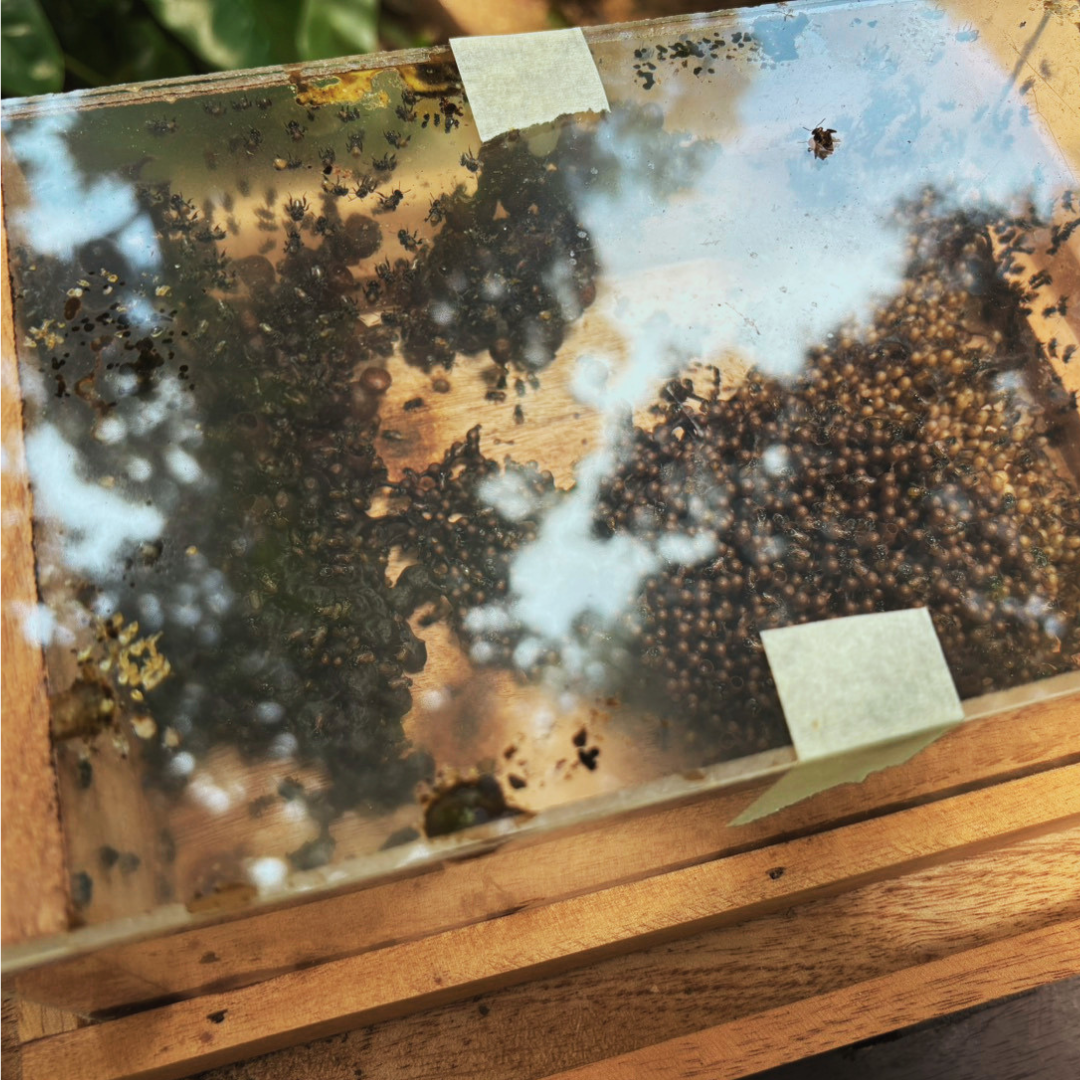
The dark waxy material these bees use to build and seal their nests is a mix of beeswax and plant resin. Beekeepers in Thailand have long valued this cerumen, and some traditional practices use it in balms and remedies. It is also what gives stingless bee hives their distinctive look, with irregular pots and tubes very different from the neat hexagonal comb of a honeybee hive.
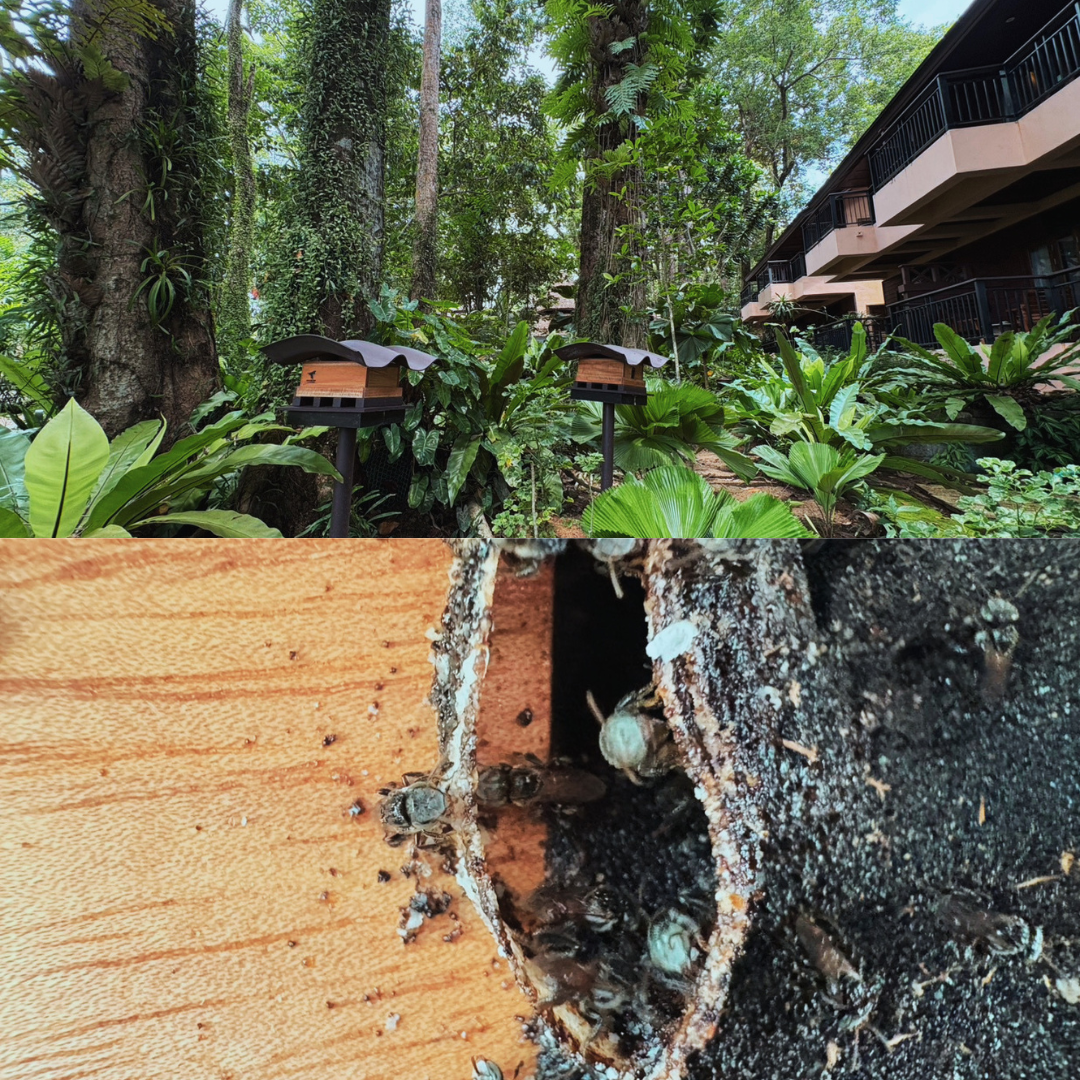
You do not need to search far. The resort keeps three artificial hive boxes set up in different spots around the grounds, placed there to help support pollination of the flowers and trees nearby. Each box can be opened up so you can look inside and see the nest structure and the bees at work up close, from the pollen storage pots to the workers moving around the brood area. If this sounds interesting, just stop by the Biologist Corner and we will be happy to show you.
Next time you are walking through the grounds, slow down for a moment near the flowers. You might just catch a flash of silver going about its quiet work.


Meet the Sea Almond, a coastal giant of extraordinary evolutionary design. From its wind-resistant canopy to bi-annual leaf color changes, this everyday tree is a master of survival. Discover why its leaves hold a secret chemical weapon that aquarium hobbyists love. Dive into its fascinating biology today!

May doesn’t announce itself loudly, but if you pay attention, it quietly holds some of the most urgent reminders on the calendar — from the hum of pollinators keeping our food systems alive, to the ancient patience of turtles that have outlasted extinctions, to the unsung scientists still busy naming the living world before it disappears.

Step outside at dusk in Khao Lak and you will hear it instantly: a rising, pulsing chorus pouring out of the trees. That sound belongs to the cicada, one of southern Thailand’s most fascinating and overlooked creatures. From the garden of Khaolak Merlin Resort to the deep rainforests of Phang Nga, these remarkable insects have been singing the same songs for millions of years. But there is far more to them than noise.


